

Learn braking distances easily for the theory test with our new Bremsespill
Quick summary for the theory test
- The square law: Double your speed and the braking distance quadruples.
- Stopping distance: This is the sum of reaction distance and braking distance.
- Road conditions: On wet asphalt the braking distance doubles compared to dry roads.
- Skip the formula cramming – try the Bremsespill to master the calculations intuitively before your test.
Now you can finally learn how to calculate braking distance, reaction distance, and stopping distance with ease! Many learner-drivers dread these calculations on the theory test, but with our new interactive Bremsespill the formulas become both understandable and logical – without you having to cram boring math.
How the Bremsespill works
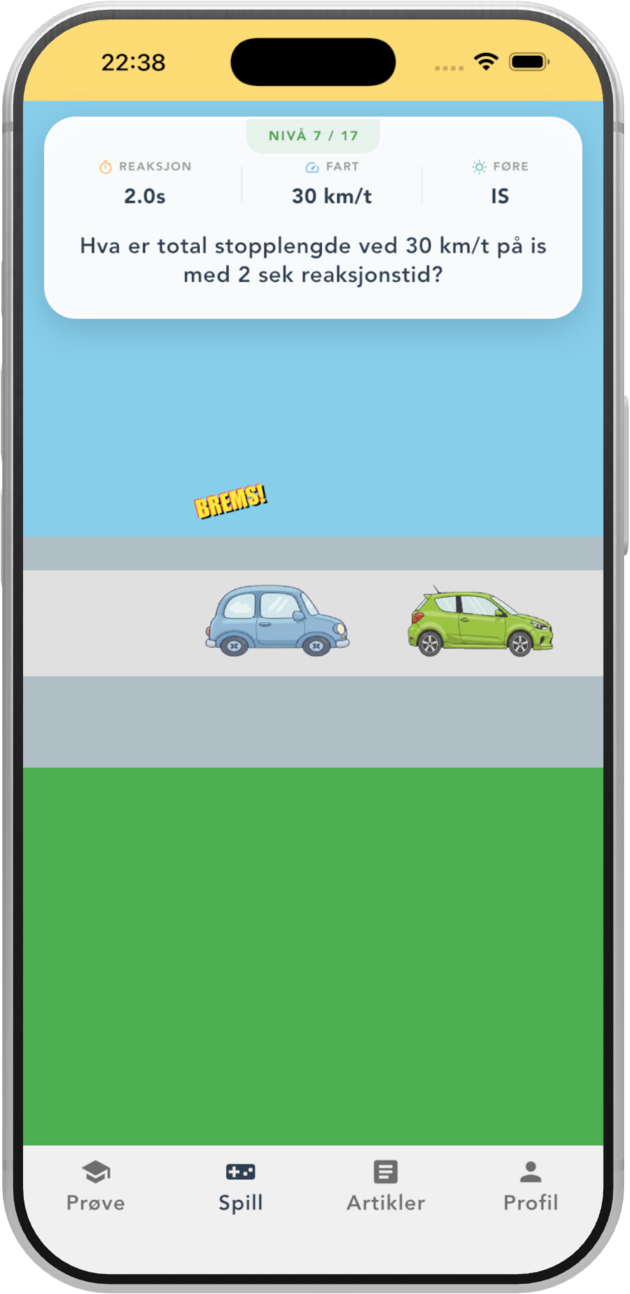
Instead of cramming dry paragraphs from a book, the game puts you into real-life scenarios. You are given a situation (for example your speed and the road conditions), and your job is to calculate the correct answer using simple rules of thumb.
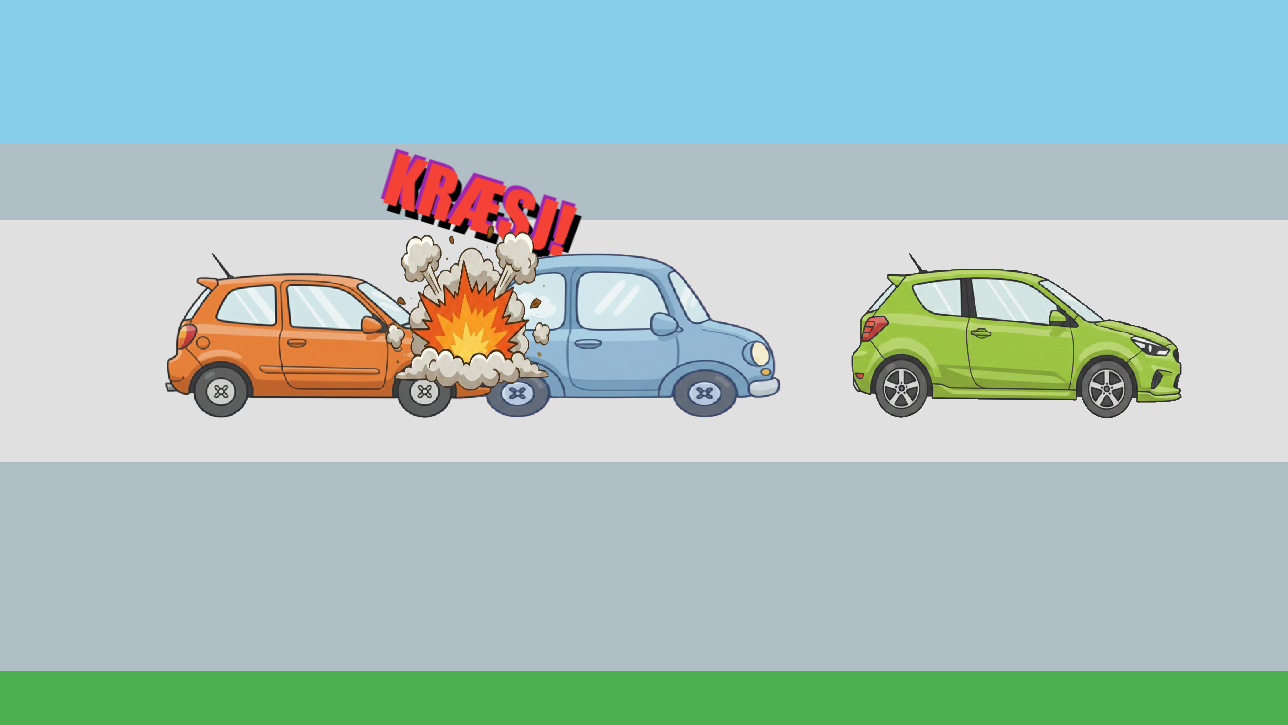
To make this smooth, the game has a built-in calculator. You type in your calculation here. Once you have submitted your answer, the simulation plays out. Did you calculate correctly? Then you see an animation of the car stopping safely. Got it wrong? Then you see the consequence in the form of a collision.
6 different task types you need to master
To make sure you are 100% ready to tick the correct answer on the theory test, the game varies the tasks so that you have to think fresh every time. Task types in the game:
- Given speed and reaction time ➔ Find the reaction distance.
- Given speed and surface (road conditions) ➔ Find the braking distance.
- Given speed, reaction time, and surface ➔ Find the total stopping distance.
- Given speed, reaction time, and surface ➔ Find the reaction distance. (Here you have to remember that the surface does not affect your reaction distance!).
- Change in speed ➔ Find the new braking distance when the speed is doubled, tripled, or halved.
- Change in surface ➔ Find the new braking distance when you go from, for example, dry asphalt to winter conditions.
In-depth explanations that make the math easy
We don't throw you in at the deep end without a life jacket. Throughout the game you have access to explanations and tips for how to solve each task most easily. If you answer wrong, you don't just find out that you got it wrong, but exactly why and how to think correctly next time.

Solid rules of thumb
In the explanations we break the heavy mathematical formulas down into simple rules of thumb. You will learn the tricks that let you solve complex questions about aquaplaning and icy roads in a few seconds in your head. The game guides you step by step through how each element affects the overall picture.
The square law of speed
One of the most important concepts the game drills you on to make sure you pass is the square law. Double your speed and the braking distance quadruples. If your braking distance is 10 meters at 40 km/h, it will grow to a full 40 meters at 80 km/h.
Rule of thumb: Multiply the speed by itself to find how much further you need to brake. Doubling the speed? 2 × 2 = 4. Tripling? 3 × 3 = 9 times the braking distance.
See the game in action
In the video you can see how the Bremsespill works in practice. You are given a situation, type in your answer, and see immediately whether the car stops safely – or crashes.
Want to learn more about the theory behind the numbers?
To calculate the braking distance for an emergency stop on dry asphalt, the usual formula is: (Speed / 10) * (Speed / 10) / 2. If you are driving at 50 km/h, the calculation becomes: (5 * 5) / 2 = 12.5 meters.
Still finding this hard to keep track of? We strongly recommend reading our thorough article on the topic. There we go even deeper into the formulas, the exceptions, and give you more examples of how road conditions affect stopping distance.