

Direction signs
What do direction signs look like?
Direction signs are square and can have several background colours, including blue, yellow, white, orange and brown. There are exceptions to this rule of thumb. Direction signs provide information about place names, services, routes, lane choices, road choices and the distance to destinations.
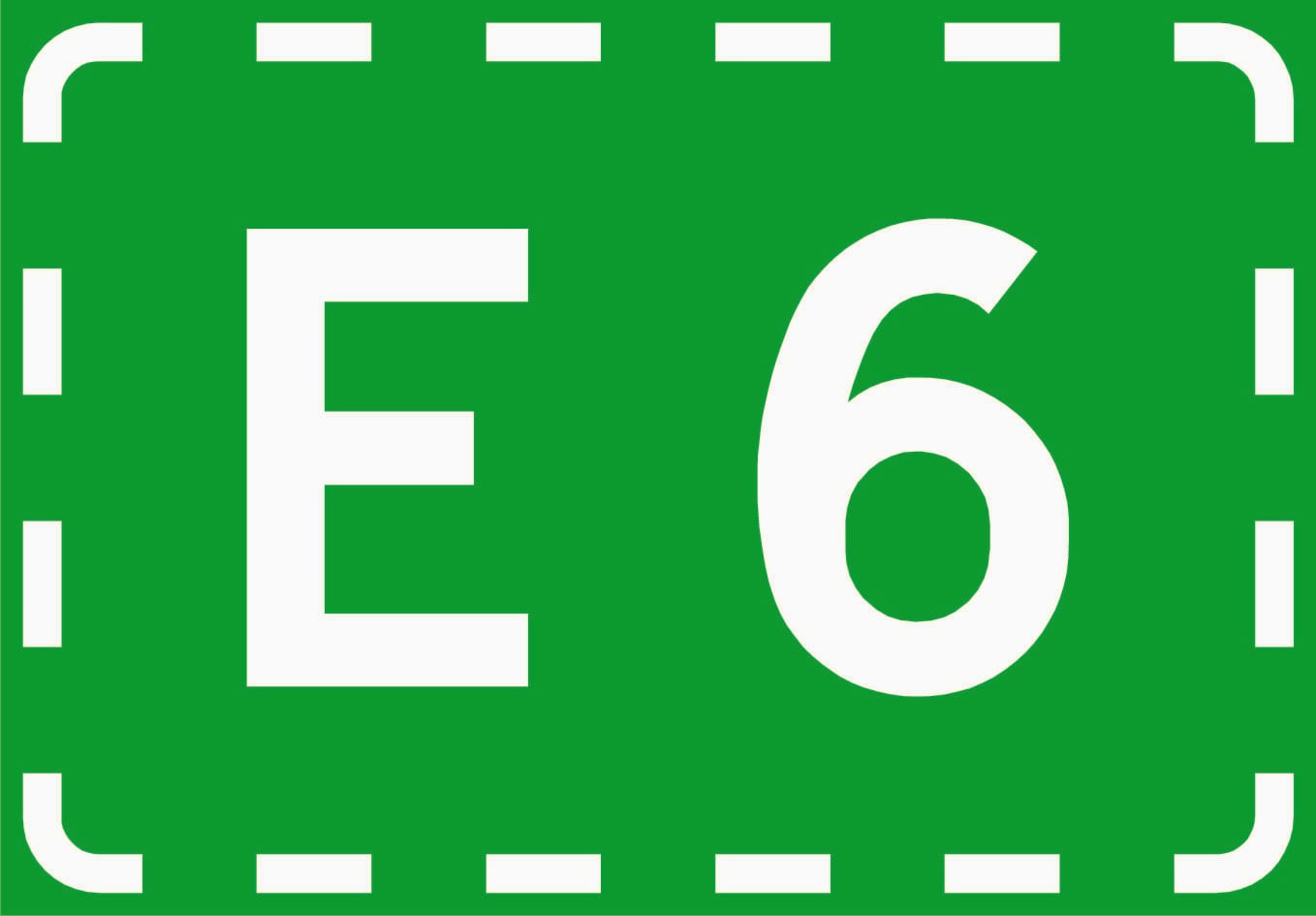
Route number for European route (variant)
Route number for European route (variant)
[object Object]
Why is the sign with a dashed white border important on the theory test?
You must be able to recognize the sign with a dashed white border, know that it marks a feeder road to an E-route, and show that you understand its use on the theory test and the driving test.
What does a dashed white border on the route number sign mean?
When the route number has a dashed white border, it means that the road you are driving on leads to the signed European route (e.g. E6), but is not the European route itself.
When do you encounter the sign with a dashed white border?
- At exits toward an E-route – warns that this road leads to the European route.
- On feeder roads – along national or county roads that lead to an E-route.
- Before junctions and roundabouts – to prepare you for joining the European route.
How do you navigate using the sign with a dashed white border?
Follow the signs marked "E" + number with a dashed white border to find the feeder road onto the European route network. This makes sure you arrive correctly without confusing it with the main route.
What is the difference between a solid and a dashed white border?
A solid white border means you are driving on the European route itself. A dashed white border shows you are on a feeder road that leads to the European route.
Frequently asked questions about the sign with a dashed white border
- Does the dashed border apply on all European routes? – No, only on feeder roads to an E-route.